
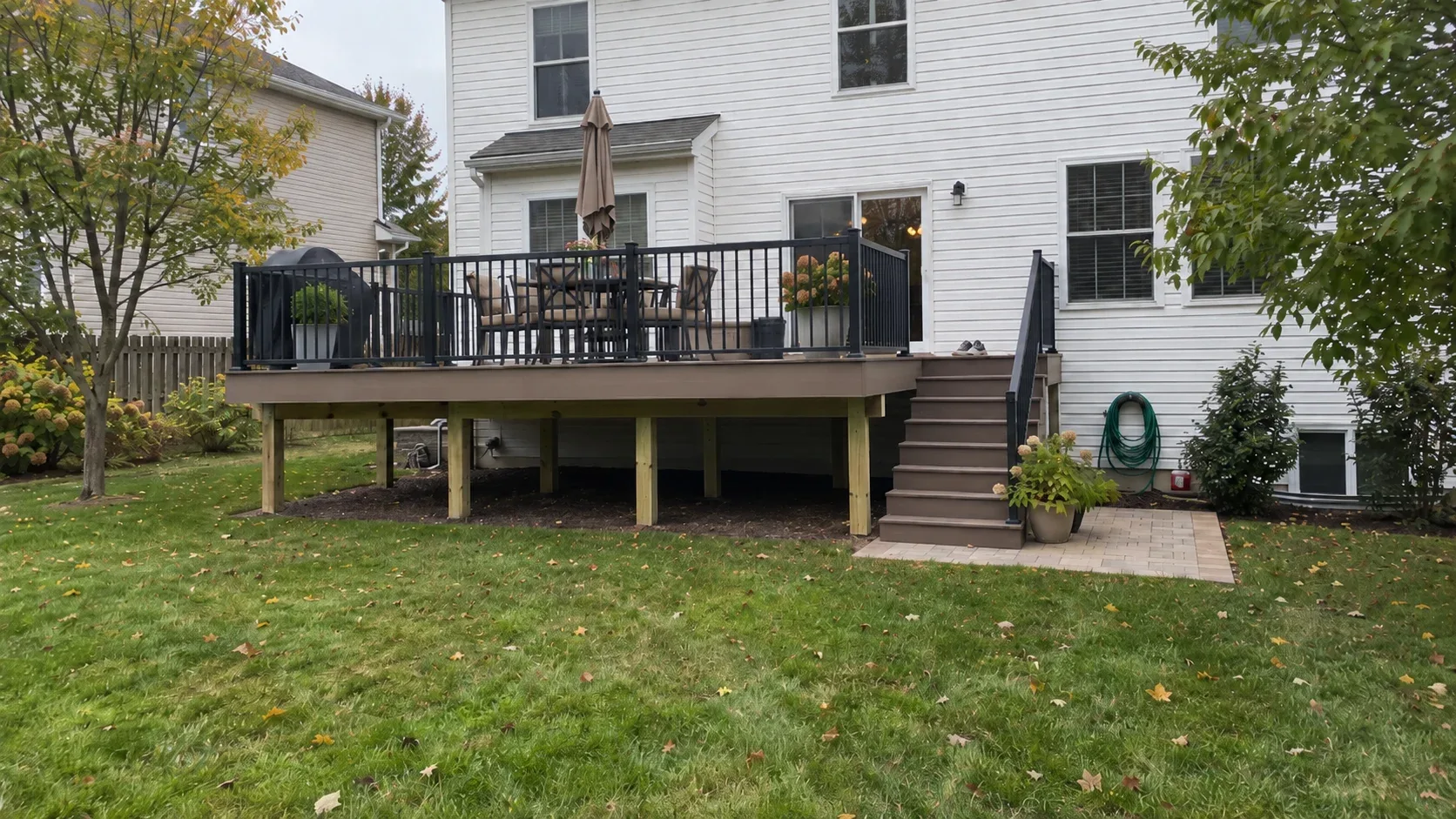
Columbus Custom Decks designs, permits and constructs decks, porches and railings serving Columbus, OH andCentral Ohio. What follows explains our approach and names the three parts we will never strip from a bid.
What we do
Decks in composite, PVC, treated pine and cedar, along with screened porches, roofed porches, railing systems, stair work, pergolas, under deck drainage and paver patios, every one detailed on paper before it is priced.
Much of what we do is taking apart decks other crews assembled, which has taught us where a build actually fails. Enough mornings spent under tired frames and the details that decide the outcome stop being debatable.
How we work
A written scope before a single board moves
Every board line, the framing schedule, the fasteners, the railing profile, the number of steps, the dates and the total are committed before work begins. If the scope shifts once we start, the change is documented and signed before anyone acts on it. A handshake agreement is how a good job becomes a disagreement on the last day.
Repair can beat replacement, and we will say so
A sound frame deserves to stay, and laying new boards over it usually lands near a third of a rebuild. It is often the honest recommendation, so we raise it before you think to ask.
Where a frame has genuinely reached the end, we say so and walk you underneath to show the decay, the hangers that have pulled and the pier that has risen, instead of asking you to accept our judgement from the top.
Permits, without exception
We lodge the application, provide the framing drawings and stand with the inspector. Around here that means working out which office holds jurisdiction over your address, since Columbus, Dublin, Upper Arlington and Westerville each issue their own permits, New Albany reviews how a build looks before it reviews structure, and Powell is handled by Delaware County.
A deck that was never inspected turns into a negotiating point when the house sells, and resolving it afterwards costs several times what the permit would have at the time.
What we would decline to build
Treated timber for a household that is never going to seal it. A dark composite board on a Dublin lot that faces west and will stay unshaded for years. A spa on a frame sized for people and furniture only. An open fire pit on a surface that can burn. Saying it before the build costs less for both sides than saying it after.
One crew, one address, until the last board
The complaint that comes up most about a bad build is not the workmanship, it is the quiet. A crew is divided across several sites, your address is the one left waiting, and the telephone never rings. When your project opens, that crew works nowhere else until it closes. If weather or an inspection moves the plan, you learn it before the original day arrives, not after.
The garden goes back as we found it
Old boards, offcuts and packaging leave in the trailer each evening instead of accumulating until the end. Before we declare it done, a magnet passes over the lawn and the earth where the old structure sat, since a single dropped screw will find a mower blade or a bare foot months afterwards.
What we will not cut
How deep and how wide the footings are, how far apart the joists sit and how the guard posts are anchored into the frame. Between them they determine whether a deck lasts a quarter of a century or needs attention inside a decade, and none can be seen once the surface is laid. That is exactly why a cheap estimate drops them first.
When a cheaper figure arrives, ask that contractor to put all three in writing. The difference between the two prices generally answers itself in one line.
Where we work
We work throughout Columbus and Central Ohio, including Dublin, Upper Arlington, Westerville, New Albany and Powell. Those five sit in Franklin, Delaware and Licking Counties, each with its own approval path, and we take care of whichever one your address falls under. The service areas page has the finer detail.
Why homeowners pick Columbus Custom Decks
Piers set below the frost depth
Ground in central Ohio lifts and settles with every freeze. Each post lands on a poured pier that reaches past the frost depth, and that is what keeps a deck flat across a decade of heave and thaw.
Approvals and sign off dealt with
We prepare the drawings, lodge the permit and stand with the inspector, then hand you the signed approval. A deck built without one belongs to the seller at closing.
A written scope first
Boards, framing detail, fixings, schedule and cost all on paper before work begins. Any later change is documented and agreed, never verbal.