
Columbus, OH and Central Ohio
Composite Decking in Columbus, OH
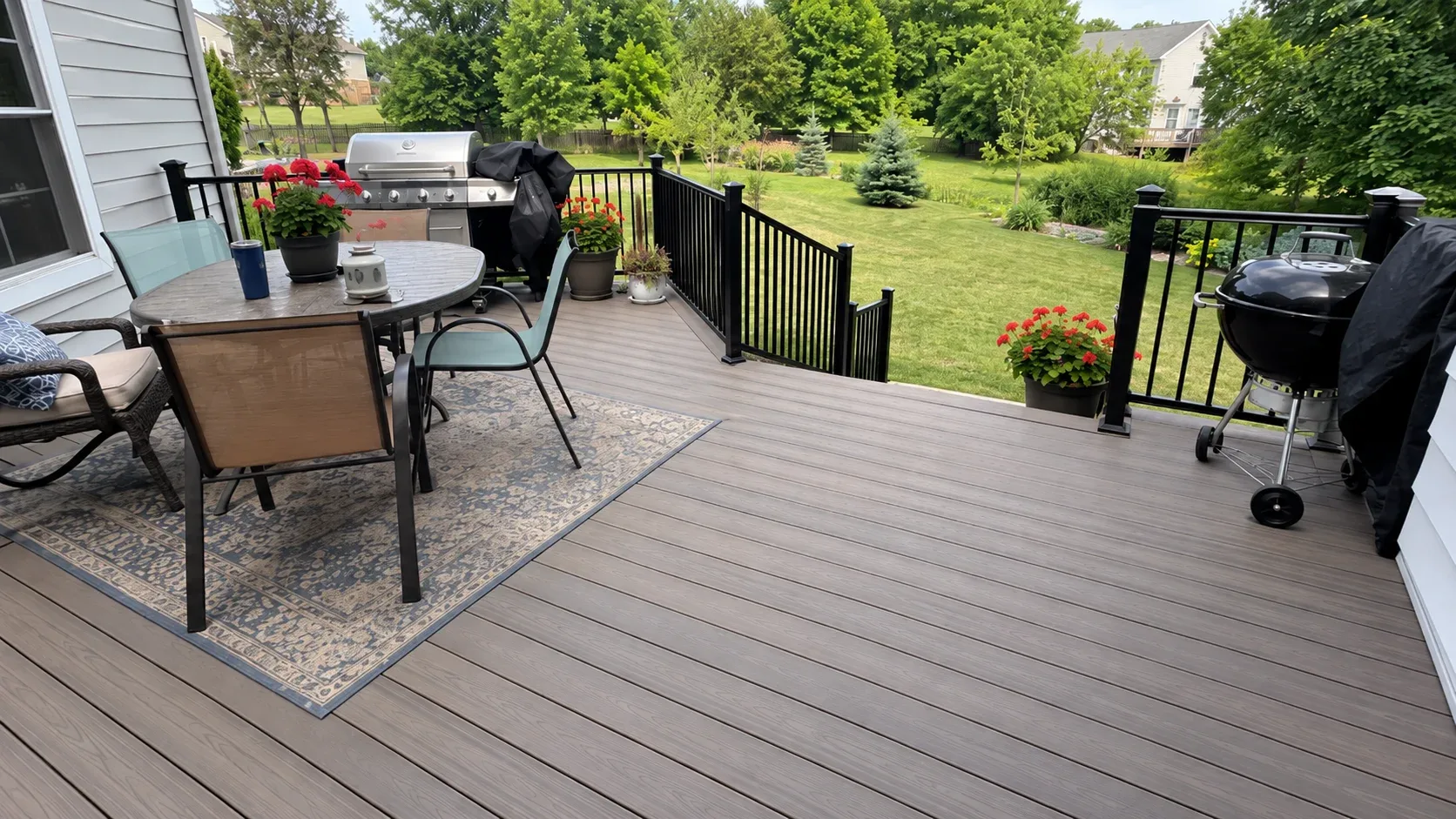
Capped composite and PVC boards fitted over a frame built to suit them. No sealing, no staining, and a surface still wearing the same colour a decade on.
- Piers set below the frost depth
- Approvals and sign off dealt with
- A written scope first
Columbus Custom Decks fits capped composite and PVC boards throughout Columbus and the surrounding counties. The frame underneath is sized to the board maker’s own table rather than to whatever spacing the last crew happened to use.
Most people who call about composite are not rescuing a collapsed structure. They are tired of a grey surface that swallowed a weekend of sanding every second spring until the year nobody bothered.
The product lines we install
Trex
The best known name in the category. Enhance sits at the value end and holds up well on a modest budget. Transcend, and the Lineage colours within it, add richer variation and a formulation meant to shed heat. The boards are built on a wood flour core and capped on three or four faces depending on the series.
TimberTech and Azek
The TimberTech composite series track Trex closely on both price and how they wear. Azek is the interesting one: a capped PVC with no wood at all in the core. With nothing organic inside, mould has nothing to feed on, and the board is light enough to carry without help. It is the priciest product we fit and it carries the longest cover in the category.
Fiberon
Concordia and Good Life are the two lines we fit most. Fiberon competes on how convincingly the darker, multi tonal boards imitate timber, which none of the entry level products quite manage. On an older home where a cool grey would fight the brick, these are the boards we lay out first.
Deckorators
The mineral based board is the odd one out and worth a look. It takes on no water, holds its dimensions where wood flour boards swell and shrink, and stays cooler to the touch. It is also the only line where a dark colour on a west or south facing deck in Franklin County is a choice you can defend rather than one you regret by August.
How we install it
Frame built to the board’s own spec
Before a single board is opened we read the maker’s installation sheet and set the joists to what it says, not to what is familiar. Standard perpendicular runs want 16 inches between centres, a 45 degree lay wants 12, and every stair tread wants 12 whatever the layout. If we are covering an old frame set at 24 inches, we add joists alongside the existing ones or we tell you straight that the frame is not worth saving.
Joist tape on every joist and beam
A butyl strip caps the top face of each framing member. It wraps every screw as it drives and stops water from pooling in the hole. The boards may carry a fifty year cover, but the frame gives out first, and tape is the least expensive way to buy that frame another decade.
Hidden fasteners
Boards with a grooved edge take a clip system that holds a uniform gap and leaves the field free of screw heads. Running screws through the face of a grooved board is quicker and it looks it. Border boards and stair treads get face fixed with colour matched screws where the system calls for it.
Gapping set on the day
The material expands and contracts with the weather. End gaps come off the maker’s chart using the temperature on the morning of the install, so a run laid in February is spaced differently from one laid in July. Butt boards tight on a cold day and they will lift by the following summer.
Picture framing and fascia
A mitred border around the edge conceals the cut ends of the field and is the moment a composite deck stops looking like a floor and starts looking finished. Fascia closes the rim. Both need blocking fitted inside the frame, so the choice has to be made before the frame is closed up rather than after.
Composite against the alternatives
Against pressure treated
Treated comes in at roughly half the installed figure. It then asks for a clean and a fresh seal every two or three years to stay presentable, and it will still check and splinter. Composite costs more on day one and then almost nothing. Around here the two lines cross on total spend somewhere between year ten and year twelve.
Against cedar
Cedar looks better the day it goes down and most people prefer real grain underfoot. It is also soft enough to dent under a chair leg, goes silver without regular oil, and costs more than treated. Composite takes the long view, cedar takes the first summer, and on an older home cedar can still win because composite would sit wrong against it.
Against capped PVC
PVC is lighter, cooler underfoot, fully water resistant and backed the longest. It is also the dearest of the lot, and at close range the surface can read as slightly less natural than a good composite. Around a pool, on a roof deck or anywhere water actually stands, PVC is the correct answer.
What it costs, and what actually drives the number
The board itself is about a third of the installed price. Footings, framing, railing, stairs and labour account for the rest, and none of those get cheaper because you picked an upgraded board.
That is why stepping from an entry board to a mid tier one usually moves the total less than people fear, while a second stair run or a taller railing moves it more than they expect.
Railing is the other large lever. Aluminium runs about $76 to $118 per linear foot fitted, so a deck with a long edge can spend as much on railing as on boards. Under 30 inches we can often leave the guard off entirely, and that is a genuine saving rather than a rounding difference.
Maintenance, honestly
A soft brush and a composite cleaner twice a year. Clear the gaps before winter, because leaves breaking down in a gap are what stain the surface and feed mould. Keep a pressure washer well back from the cap, and use a plastic shovel rather than a steel one for snow.
That is the whole list. No sanding, no sealing, no staining.
Where we install composite decks
We fit composite across Columbus, Dublin, Upper Arlington, Westerville, New Albany and Powell.
In the newer Dublin and New Albany subdivisions composite is the expected finish, partly because design review dislikes a surface that will weather into a dispute. On a Powell walkout it is usually paired with an under deck drainage system so the space below stays dry patio.
Deck cost in Columbus, OH
Set the size and finish, then read the installed range we price from before anyone picks up a phone.
Why homeowners pick Columbus Custom Decks
Piers set below the frost depth
Ground in central Ohio lifts and settles with every freeze. Each post lands on a poured pier that reaches past the frost depth, and that is what keeps a deck flat across a decade of heave and thaw.
Approvals and sign off dealt with
We prepare the drawings, lodge the permit and stand with the inspector, then hand you the signed approval. A deck built without one belongs to the seller at closing.
A written scope first
Boards, framing detail, fixings, schedule and cost all on paper before work begins. Any later change is documented and agreed, never verbal.
Composite Decking questions we get asked
Is composite worth the extra over pressure treated?
On a twenty year view in this climate, generally yes. A treated surface wants a clean and a fresh seal every two or three years, and at Columbus labour rates that bill comes round often enough to notice. A great many owners skip it, which is why so many treated decks look worn by year eight. Composite asks roughly 60 to 90 percent more once and then a wash down twice a year. If you expect to sell within five years the sums get genuinely murkier, and we will tell you so.
Does composite get hot underfoot in summer?
Yes, and the colour choice matters more than the maker. A dark board on a west or south facing surface in July is unpleasant under bare feet. Pale greys and tans stay noticeably cooler. Deckorators mineral boards and the TimberTech Azek PVC series are made to run cooler than standard composite. On the open, unshaded lots through Dublin and New Albany this is the decision owners most often tell us they would take back, so we raise it before a colour is picked.
What joist spacing does a composite deck need?
Most capped boards call for joists at 16 inches on centre on a perpendicular lay and 12 inches on a 45 degree lay. Certain products, and every stair tread, want 12 inches whatever the layout. Set the frame at 24 inches and lay composite over it and you get a springy deck plus a void board warranty, which is by a wide margin the fault we find most often on work another crew left behind.
Do composite boards take scratches?
A capped board shrugs off scratching far better than the uncapped composite of fifteen years ago, but no surface is immune. Slide a steel chair or a loaded grill across any deck and it leaves a mark. Felt pads under furniture feet prevent nearly all of it. Makers cover scratching under the surface warranty only in narrow cases, so treat it as a habit rather than a promise.
Can composite go over the frame I already have?
Now and then, and we crawl under before we answer. We look at the joist spacing, the condition of the joists, the beam size, the post bases and how the ledger meets the house. A frame set at 24 inches needs extra joists run alongside, and a nailed ledger has to be put right before any new board goes down. A fifty year surface on a frame with eight years left is money wasted, and you should hear that before the boards are ordered.
Does composite grow mould?
It can appear on the shaded underside and in the gaps, and a wet Franklin County spring is the exact weather for it. What grows is surface mould feeding on dirt and leaf matter, not rot working through the board. A composite cleaner twice a year keeps it away. Leaves left sitting in the gaps through winter cause the worst cases, which is why it shows up most under the dense tree cover in Upper Arlington.
If a board fades or fails, does the warranty really replace it?
Read the material cover and the labour cover as separate documents, because the makers do. The material side replaces the faulty board itself, and on several brands it is prorated after the first few years, so a claim at year fifteen can return part of a board rather than a whole one. Labour to lift the old board and set the new one is often a separate line that many makers exclude unless the job was registered with them when it was built. We register the warranty in your name once the work is done and leave the paperwork with you, so any future claim is already on record.