
Columbus, OH and Central Ohio
Deck Staining and Sealing in Columbus, OH
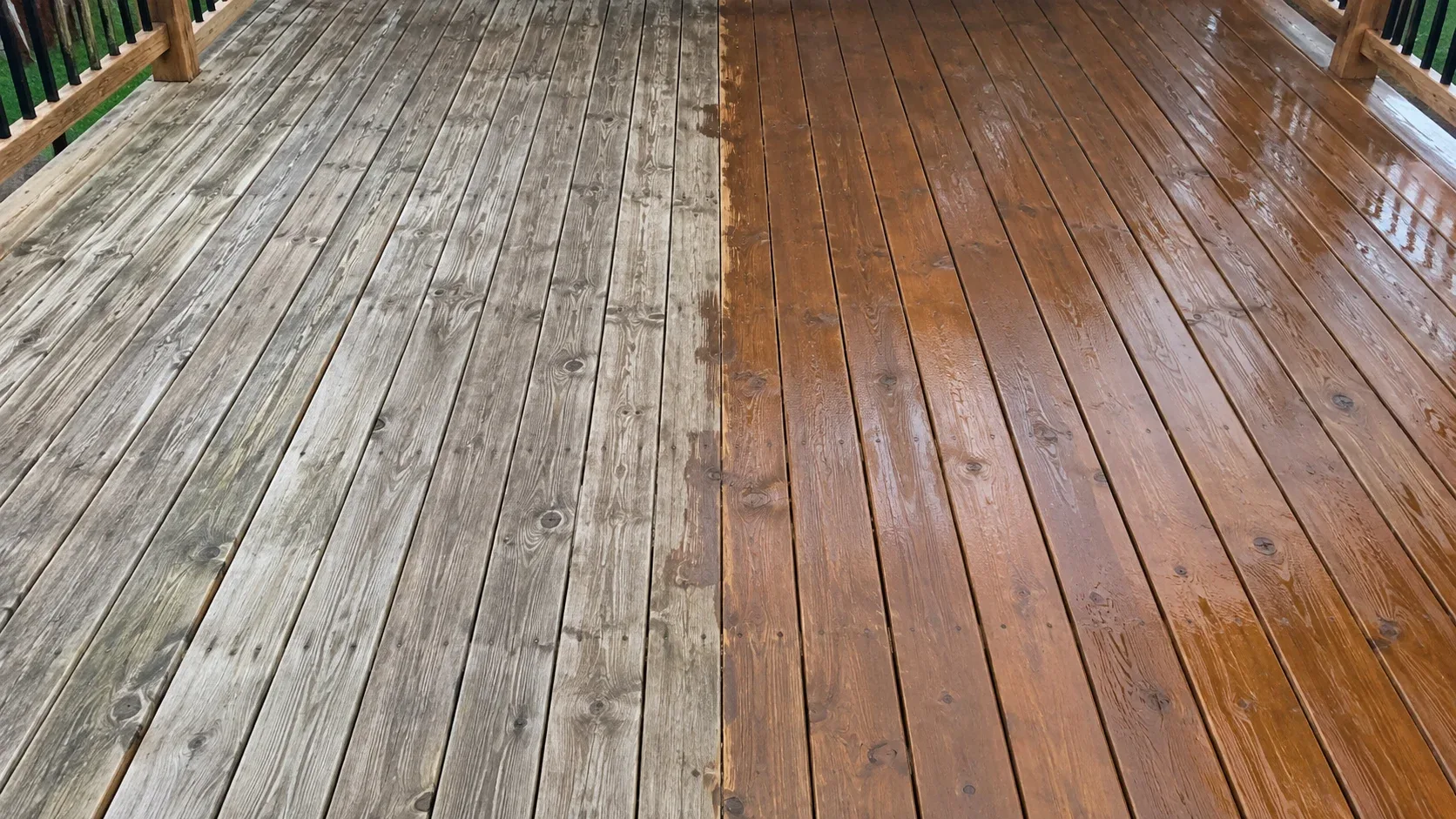
Wash, brighten and sand where the boards call for it, then work in a penetrating finish that holds through an Ohio winter. The least costly way to keep a timber deck in service.
- Piers set below the frost depth
- Approvals and sign off dealt with
- A written scope first
Columbus Custom Decks washes, brightens and seals timber decks throughout Columbus and Central Ohio.
It is the plainest work we do and it repays more than anything else on the list. Sealing on a two to three year rotation is what separates a deck that still looks respectable at twenty from one that is gone at eight.
What the job involves
Look it over first
Before any liquid touches the timber, we note loose boards, fasteners standing proud, soft patches and any movement in the guard. Finishing a board that ought to be replaced wastes the work, and a deck with a structural fault wants repair before it wants any coating.
Wash
A cleaner chosen for the species and the existing finish, worked in and rinsed at low pressure. The solution lifts mildew, algae and dead grey fibres. The water is only there to carry it away.
High pressure on softwood raises the grain and creates the fuzzy surface that people then complain about, which is why the cheapest wash in the neighbourhood often leads to a sanding bill the next year.
Brighten
An acidic brightener neutralises the cleaner and brings the wood back to its natural pH and colour. Missing this step is why some finishes dry blotchy: a surface left alkaline will not take stain evenly, and no amount of extra coating fixes that afterwards.
Sand only where required
Not every deck needs it. Where boards show raised grain, mill glaze or the ghost of an old finish, sanding gives the new stain a surface to grip. Stairs and handrails get extra attention because they are the parts hands actually touch.
Apply the finish
Penetrating oil based semi transparent stain as the standard, brushed or rolled and then back brushed rather than sprayed alone, so it is worked into the grain rather than sitting on top.
Two thin coats outperform one heavy one every time. A thick coat that cannot soak in leaves a tacky surface that never cures properly, and through a humid Columbus June that can take weeks to settle down.
Let it cure
Stay off the deck for a day or two, depending on temperature and humidity. Furniture goes back after that, and planters belong on feet rather than resting flat where they trap water against the boards.
Picking a finish
Clear sealer
Repels water and does very little about UV. The deck still greys, just more slowly. Inexpensive and the quickest to need redoing. A fair choice on a covered porch that never sees direct sun.
Semi transparent stain
Pigment for UV defence with the grain still readable. This is what we put on most decks here, and it is the best available balance of appearance, protection and time between recoats.
Semi solid and solid
More pigment, more hiding, less grain. Useful where boards no longer match one another or where a coating already exists. Worth knowing that the more film a product builds, the more likely it is to peel rather than wear away.
What to steer clear of
Deck paint and thick film forming products. They look superb for two seasons and then lift, and stripping four hundred square feet of failed film is the worst task in this trade by a wide margin.
What drives the price, and why guards change it
The deck surface prices out as simple square footage. Guards do not. A guard system has two faces, a top rail and a bottom rail, and each baluster has four sides to coat.
A forty foot run of guard can carry more coatable area than the deck it encloses, and it takes far longer per square foot because none of it can be rolled.
That is the main reason a finishing quote for a deck with heavy timber guards comes in above what people expect, and one of the stronger cases for moving to aluminium railings, which never need coating at all.
When a finish will not save it
Boards that are deeply checked, cupped, or throwing splinters that sanding cannot remove will not be rescued by any product. Replacing the decking over a sound frame costs more than a stain and it is the correct spend.
We will tell you which of those two situations you are in when we visit, and that visit costs nothing either way.
Where we finish decks
Across Columbus, Dublin, Upper Arlington, Westerville, New Albany and Powell.
Upper Arlington and the older streets of Westerville generate most of this work, because a heavy tree canopy keeps those decks damp for longer and the finish there lives a harder life than one on an open subdivision lot.
Deck cost in Columbus, OH
Set the size and finish, then read the installed range we price from before anyone picks up a phone.
Why homeowners pick Columbus Custom Decks
Piers set below the frost depth
Ground in central Ohio lifts and settles with every freeze. Each post lands on a poured pier that reaches past the frost depth, and that is what keeps a deck flat across a decade of heave and thaw.
Approvals and sign off dealt with
We prepare the drawings, lodge the permit and stand with the inspector, then hand you the signed approval. A deck built without one belongs to the seller at closing.
A written scope first
Boards, framing detail, fixings, schedule and cost all on paper before work begins. Any later change is documented and agreed, never verbal.
Deck Staining and Sealing questions we get asked
How frequently does a deck here need sealing?
The flat boards want attention every two to three years. Guards and vertical faces often stretch further because rain runs off them and they catch less direct sun. Boards facing south or west will ask sooner. The check costs nothing: flick a little water across the surface, and if it sinks in instead of standing in beads, the finish is spent and the timber is drinking.
Can a brand new deck be sealed straight away?
No. Fresh pressure treated stock arrives damp from the treating plant, and coating it while it is still wet locks that moisture in and shortens the life of the finish. We normally wait two to four months and then run the water test before anything is applied. Cedar and kiln dried boards can often be coated earlier.
How does a sealer differ from a stain?
A clear sealer pushes water away and does almost nothing about ultraviolet light, so the timber greys anyway, only more slowly. A semi transparent stain carries pigment, and pigment is what actually intercepts UV, so the colour lasts far longer. A solid colour product behaves much like paint and covers the grain completely. In this climate the semi transparent middle ground is the one that makes sense.
Why has my deck finish started to peel?
Almost always a film forming product, or a coating applied over a surface that was damp or dirty. A film sits on top of the boards and cannot flex with them through repeated freezing and thawing, so it splits and lifts. Penetrating oil sinks in and wears away evenly instead of peeling. Taking a failed film off is the most expensive task in this line of work, and it is entirely preventable.
Do you use a pressure washer on the deck?
We clean at low pressure and let the solution do the work rather than the water. High pressure tears open the surface fibres of softwood, which is exactly what leaves a deck feeling fuzzy and shedding splinters afterwards. Where washing is not enough, the boards need sanding rather than more pressure, and we will tell you so.
Can a composite deck be stained?
Capped composite should not be stained and has no need of it. Older uncapped boards from fifteen or more years ago can sometimes be cleaned and coated with a product made for that purpose, though the outcome varies and the coating will want redoing. Where an old composite deck looks tired, new boards over the existing frame is usually the better spend.