
Columbus, OH and Central Ohio
Deck Lighting in Columbus, OH
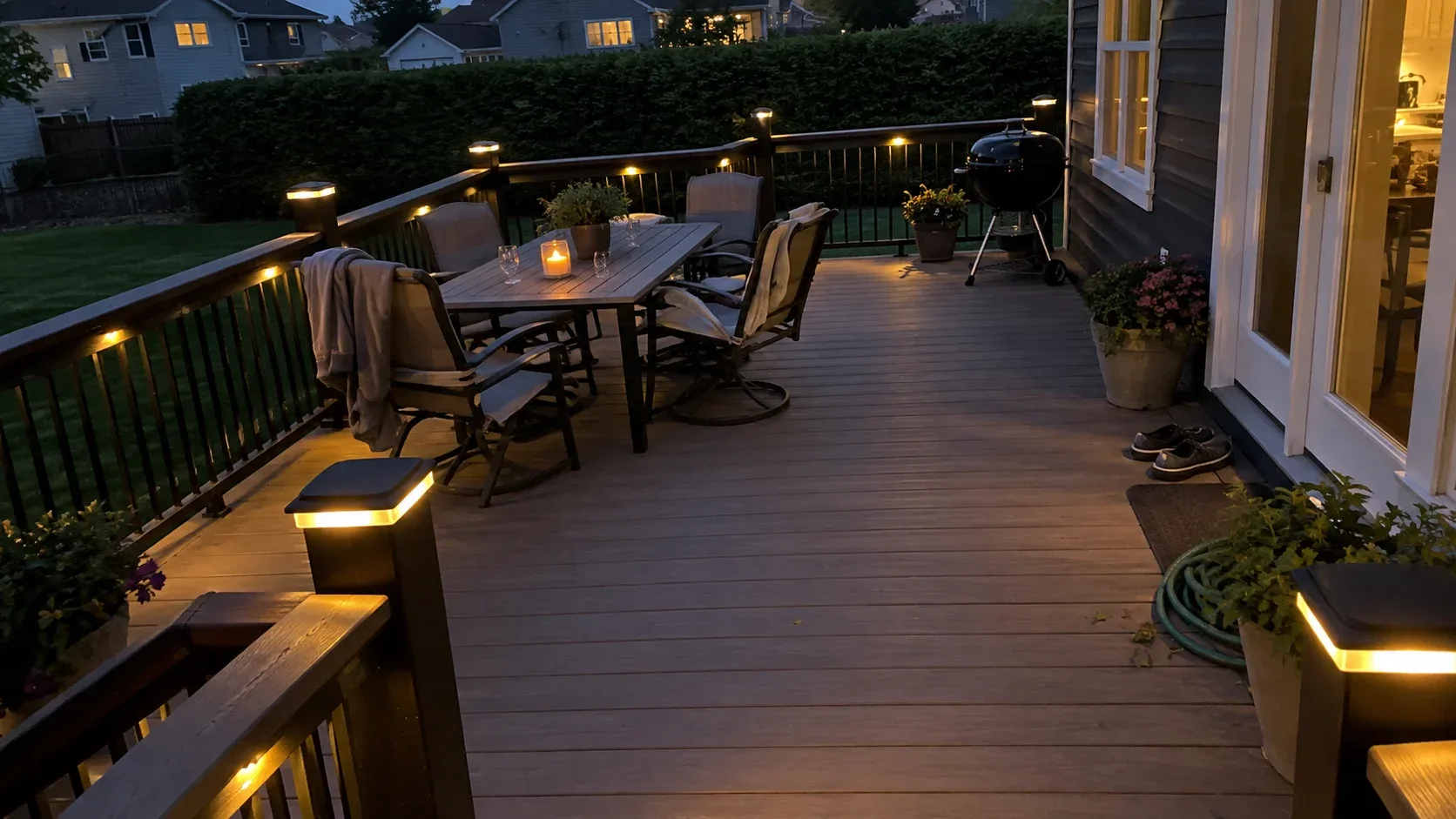
Riser lights, strips beneath the handrail and lit post caps, cabled while the frame is still open so nothing is visible once the boards go down. Low voltage, dimmable, on a timer and inexpensive to run.
- Piers set below the frost depth
- Approvals and sign off dealt with
- A written scope first
Columbus Custom Decks installs low voltage deck lighting across Columbus and Central Ohio: lights let into the stair risers, strips beneath the handrail and lit post caps, all cabled while the frame is still accessible.
The lighting line is a small share of any estimate and it decides how many evenings the finished deck is actually used. Measured against that, it is usually the best value item on the page.
Where the light belongs
The steps
A light set into each riser, or into every second one, turns a dark flight into something you can read at a glance. Safety comes first and the look is a happy byproduct.
With the long descents that the wooded, dropping ground around Powell demands, riser lighting is less a luxury than the reason the lower level gets any use after dark.
The perimeter
An LED strip beneath the top rail throws a soft wash across the boards and marks the edge without a visible fitting. For the spend it does more than any other item here, because one continuous run reads better than a scatter of separate points.
The guard posts
Post cap lights are the ones visible from indoors, so they carry most of the job of making the deck look worth stepping out onto from the kitchen. They illuminate themselves rather than the floor, which is exactly what they are for.
The ceiling, when there is one
On a covered porch or beneath an under deck ceiling, recessed fittings in the ceiling become the primary source, and they deserve their own switch and dimmer.
How the system goes together
Low voltage, with the transformer at the house
The transformer sits at the house wall and drops the supply to 12 volts. Everything past that point runs at low voltage, which is safe in wet weather and simple to extend. It is sized with spare capacity so additional fittings can be added later without a replacement.
Cable pulled during framing
Through the posts, beneath the top rail and behind the riser boards. Holes are drilled where they weaken nothing structural and the cable is clipped clear of fixings. This is the whole reason the decision wants making early rather than late.
Timer or photocell control
On at dusk, off at a chosen hour. A system that needs somebody to remember the switch gets used far less than one that takes care of itself, and over a season that gap is not small.
Separate zones
Steps on one circuit and ambient light on another is worth the small extra on any larger deck. Riser lights are a safety measure and should be able to run without the entire surface being lit.
Getting the appearance right
Warm, not cold
A warm colour temperature feels like firelight and suits an outdoor room. Cool white turns the space into a warehouse aisle. That one choice shapes the finished mood more than anything else here, and it costs nothing to get right.
Softer output, more fittings
A number of gentle lights outperform a handful of strong ones, and they cut the glare that hits anyone seated. Deck lighting is something to look past rather than at.
Leave the yard dark
Floodlights fixed to the house and aimed at the deck defeat the purpose and irritate the neighbours, which on the tighter lots through Upper Arlington is a practical matter rather than a courtesy. If you also want security lighting, put it on its own switch with a motion detector.
Lighting a deck that is already built
It can be done, and the practical options are lit post caps, rail strips fixed to the surface and solar units. Recessed riser and floor lights need a route behind the board, which usually means lifting a riser or a stretch of decking.
We will be straight about which of those finish neatly and which will always show something, and that list is shorter than most people expect.
Communities we light
Across Columbus and the neighbourhoods around it, including Dublin, Upper Arlington, Westerville, New Albany and Powell.
Deck cost in Columbus, OH
Set the size and finish, then read the installed range we price from before anyone picks up a phone.
Why homeowners pick Columbus Custom Decks
Piers set below the frost depth
Ground in central Ohio lifts and settles with every freeze. Each post lands on a poured pier that reaches past the frost depth, and that is what keeps a deck flat across a decade of heave and thaw.
Approvals and sign off dealt with
We prepare the drawings, lodge the permit and stand with the inspector, then hand you the signed approval. A deck built without one belongs to the seller at closing.
A written scope first
Boards, framing detail, fixings, schedule and cost all on paper before work begins. Any later change is documented and agreed, never verbal.
Deck Lighting questions we get asked
Is deck lighting worth the money?
On any deck with a flight of steps the riser lights earn their place on safety alone, because an unlit stair is where a visitor is most likely to be hurt on your property. Beyond that it settles whether the deck falls out of use at dusk or stays in service all evening, and those late hours are much of why people want a deck at all.
When should the lighting go in?
While the frame is open, before the decking and guards are fitted. The cable travels inside the posts, beneath the rail and behind the riser boards, and once the surface closes every one of those routes becomes awkward. A retrofit is possible, but it costs more and seldom finishes as neatly. If lighting is even a possibility, we pull the cable and cap it, which is inexpensive.
Is low voltage safe outdoors?
It is, and it is the normal approach for a deck. A transformer at the house brings 120 volts down to 12, and every fitting past that point works at low voltage. It is safe when wet, it avoids the conduit and burial depth rules that line voltage carries, and a failed fitting is cheap to replace.
What does it cost to run?
Very little. A full LED system usually draws less than a single old incandescent bulb. On a timer or a photocell it comes on at dusk and goes off at a set hour without anyone thinking about it, which is also why it gets used rather than left dark.
Can lights go under the deck as well?
Yes, and where there is an under deck ceiling it is among the better upgrades, because the void gives you a route for cable and a surface to recess fittings into. Without a ceiling, surface mounted low voltage lights fixed to the joists work well and are easy to add later.
Will it be too bright?
It should not be. Deck lighting exists to reveal edges, steps and faces rather than to light the garden. We specify a warm colour temperature, low output fittings and a dimmer where it suits. A deck lit like a car park is genuinely worse than one with no lighting at all.