
Columbus, OH and Central Ohio
Paver Patios and Hardscapes in Columbus, OH
Paving laid over a sub base deep enough to come through a Central Ohio winter. Frequently the least expensive route to more usable outdoor room, and the only safe place for an open fire.
- Piers set below the frost depth
- Approvals and sign off dealt with
- A written scope first
Columbus Custom Decks lays paver patios and hard landscape throughout Columbus and Central Ohio, over a sub base deep enough to take the winter here.
Not every outdoor space wants a deck. Where the door opens close to grade, paving returns more usable area for the money and it hosts a fire pit safely, which no deck surface ever will.
How the sub base is built
Digging to subgrade
Down to firm, undisturbed ground. Through the heavy clay that runs under much of Central Ohio that means going deeper than a quote written to a bare minimum, and pulling out soft pockets rather than bridging over them.
Separation fabric
A geotextile laid between subgrade and aggregate wherever clay is present, which stops fines migrating downward over the years. Inexpensive, quick to place and the reason a sub base still holds its depth in year twenty rather than year eight.
Compacted aggregate
Usually six to eight inches beneath paving, spread and compacted in separate lifts rather than tipped in one pile and rolled once. Each lift packed properly is what produces a surface that settles evenly or not at all.
Bedding and edge restraint
A thin screeded bed, then the units, then a restraint pinned down into the base around the whole perimeter. Leave the restraint out and the outer course drifts outward a little each season while the field behind it works loose.
Hardened joint sand
Swept across, wetted and left to set firm within the joint. It locks the units together, resists washout and holds most weeds back. It will want refreshing every few years, and anyone who says otherwise is selling rather than explaining.
What we lay
Patios
Concrete paver in the common formats and colours, or natural stone where the budget and the architecture both suit it. Bluestone on an older Upper Arlington property reads correctly in a way a modern concrete paver never quite manages, and the same logic holds for a century home near Uptown Westerville.
Walkways
Front approaches, side routes and the descent from a deck stair to paving. Narrow work costs more per square foot than open ground, because there is more edge work and more cutting for each unit of area.
Seating walls and retaining
A seating wall gives permanent seating around a fire pit with no furniture at all, and on a slope it doubles as low retaining. Past a certain height it becomes an engineered retaining structure with its own approval and drainage requirements, and we will show you where that line falls on your ground.
Fire pits
Burning wood or gas. A built in wood pit on paving is straightforward, and it is one of the primary reasons to pick paving over extending a deck, because an open fire on a wood or composite surface is not something we will build. Gas features need a supply line and usually approval.
Steps between deck and paving
The transition is where these projects are won or lost. A landing that sheds water rather than holding it, an even rise on every step, and a surface that stays safe when wet.
Where paving wins and where a deck wins
Level ground and a door near grade favour paving. Sloping ground and a raised door favour the deck, because a deck steps over a difficulty that paving must regrade or retain its way around.
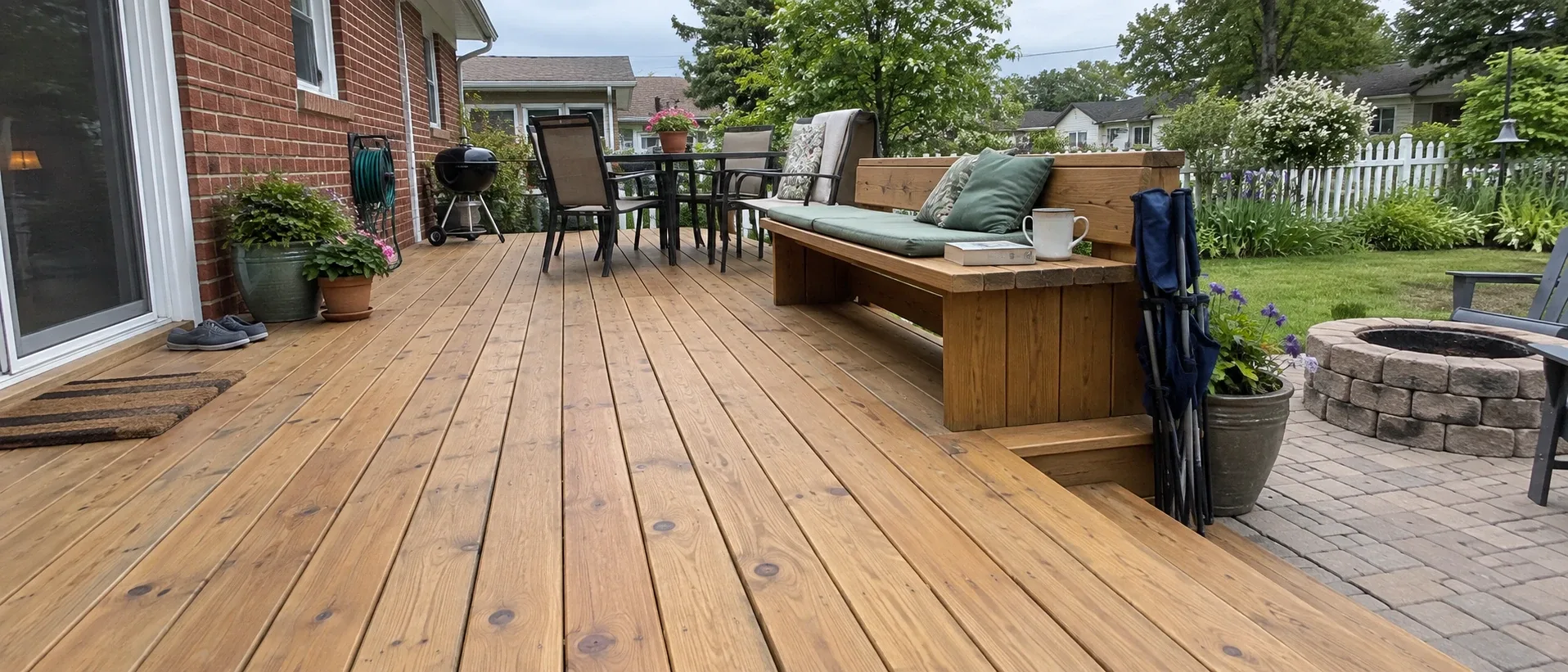
The best answer on plenty of Central Ohio lots is both. A deck at the door for the table and the grill, steps down to paving for the fire pit, each part sized to do one job properly. It generally costs less than one enormous deck and it is a far nicer place to spend an evening.
On the flat open lots around Dublin this pairing is close to the default, with a pergola over the lower space to give it the feel of a room rather than a slab.
Where we build patios
Across Columbus, Dublin, Upper Arlington, Westerville, New Albany and Powell.
Deck cost in Columbus, OH
Set the size and finish, then read the installed range we price from before anyone picks up a phone.
Why homeowners pick Columbus Custom Decks
Piers set below the frost depth
Ground in central Ohio lifts and settles with every freeze. Each post lands on a poured pier that reaches past the frost depth, and that is what keeps a deck flat across a decade of heave and thaw.
Approvals and sign off dealt with
We prepare the drawings, lodge the permit and stand with the inspector, then hand you the signed approval. A deck built without one belongs to the seller at closing.
A written scope first
Boards, framing detail, fixings, schedule and cost all on paper before work begins. Any later change is documented and agreed, never verbal.
Paver Patios questions we get asked
Does paving cost less than a deck?
At ground level, usually, at roughly 20 to 33 dollars per square foot against 37 to 63 for a treated deck and more again for composite. The gap widens as the ground flattens and closes quickly as it slopes, because paving on a slope needs regrading and retaining that a deck simply steps over. On a walkout lot in Powell a deck is frequently the cheaper answer than the excavation paving would demand.
How deep should the sub base go here?
Deeper than most quotes allow for. We build on compacted aggregate, normally six to eight inches beneath paving and more under anything that carries a vehicle, over prepared subgrade, with a separation fabric between the two wherever the soil is clay. Freeze and thaw around Central Ohio finds every shortcut taken below the surface, and paving that heaves after two winters was almost always under built where you cannot see.
Will weeds come through the joints?
Far fewer with polymeric sand, which sets hard inside the joint and resists both seed and washout. It is not permanent. Expect to top the joints up every few years, especially along the edges and wherever water crosses the surface. Plain sand is cheaper and will hand you weeds inside a single season.
Can a fire pit sit on paved ground?
Yes, and it is one of the better arguments for paving rather than extending a deck, because an open fire on a combustible deck surface is a genuine problem and not a theoretical one. Clearances from the house, the property line and anything overhead still apply. A gas feature needs a supply line and normally approval.
Should I choose a deck or a patio?
Where the door sits close to grade and the ground is reasonably level, paving delivers more square footage per dollar. Where the door is a metre or more above grade, or the ground falls away, a deck costs less because it steps over the difficulty instead of regrading it. Many of the best gardens we build use both: a deck at the door and paving below, joined by steps.
Is a permit needed for a patio?
Ground level paving normally needs none, though zoning rules on lot coverage and impermeable surface still apply, and they bite hardest in the newer subdivisions and on the narrow Upper Arlington lots. A retaining wall past a set height, and any gas line for a fire feature, do need approval. We confirm before anyone breaks ground.