
Columbus, OH and Central Ohio
Deck Repair in Columbus, OH
Boards that have gone soft, a frame that bounces, a railing that gives when you lean on it. We work out what is truly wrong, tell you whether repairing or replacing is the better money, and put it right.
- Piers set below the frost depth
- Approvals and sign off dealt with
- A written scope first
Columbus Custom Decks repairs decks throughout Columbus and Central Ohio: decayed boards, guards that move, footings that have heaved, ledgers that have failed and stairs that are no longer safe.
The valuable part of a repair visit is not the carpentry. It is establishing which of those problems you actually have, and whether the deck is worth spending money on at all.
What goes wrong on decks around Columbus
The house connection
Where the deck meets the wall. If the ledger was face nailed rather than bolted, or flashed with a cheap self adhesive tape that has since failed, water has been finding its way into the rim joist for years. This joint sits behind most recorded deck collapses, it is entirely hidden from above, and it is the first thing we examine on every visit.
Decks on the older streets of Upper Arlington and around Uptown Westerville show it more often, and the reason is simply their age.
Footings that were never proper footings
Concrete blocks set on the surface, or posts dropped into an open hole and backfilled with soil. Both seem to work for a few winters. Then freeze and thaw lifts them and sets them down somewhere slightly different, the deck loses its level, the boards open up and the guards work loose. A hole left full of water is the usual cause, and the correct detail is concrete in the hole with the post bearing above grade. Re footing is disruptive and it is the only genuine remedy.
Decay where posts and beams meet the ground
Any spot where end grain meets concrete or soil, and any beam end tucked into a pocket that traps water. A post can look sound at eye level and be soft at the base, so we probe rather than assume.
Water sitting on the joists
Standing water collects on the top face of each joist at every fixing point. Frames assembled without joist tape decay from the top down, and the first clue is usually a springy patch underfoot rather than anything visible.
Guards that shift
Posts bolted through the decking instead of to the frame, or notched so deeply that little strength is left in them. The code expects a guard to take a real lateral load. One you can rock with a hand does not.
Steps
Uneven risers, a handrail missing, a bottom tread landing on bare soil, stringers cut so deep that barely any timber remains. Steps carry the heaviest traffic on a deck and receive the least attention, and on the dropping ground near Powell the runs are long enough that it matters more.
How we work out what is wrong
We walk the deck and then we get underneath it. Posts, footings, beam bearing, joist condition, hanger type and corrosion, ledger fixing and flashing, guard attachment and stair geometry.
You receive a plain list: what is failing, what is urgent, what can wait, and what each repair costs. We show you your own deck and nothing else.
Where the frame has passed the point at which repair makes sense, we say so and price a replacement instead. That is a worse result for you and a bigger job for us, and discovering it halfway through helps nobody.
The repairs we carry out most often
Surface board replacement
Lifting failed decking and laying new, either matching what is there or moving to composite over the existing frame. Where the frame is genuinely sound this is the best value repair going, because it renews the surface you touch and see for about a third of the price of a full rebuild.
Structural corrections
Sistering joists, putting in a mid span beam and footings to take the bounce out of a frame, replacing decayed posts, re bearing beams, and correcting hangers fixed with the wrong nails. The copper now used to treat lumber corrodes ordinary steel fixings, so plenty of older decks carry hangers doing far less than they appear to.
Fixing a failing ledger
Removing the trim, exposing the joint, renewing the ledger where it is compromised, bolting it correctly and flashing it properly. If the rim joist behind it has decayed, that is repaired first. It is not a cheap job and it is not an optional one.
Railing rebuilds
Bringing guards back to code height and opening size, with posts anchored into the frame using fittings rated for that load instead of screws driven through the boards. This is usually the moment to move to aluminium and stop repainting for good.
Rebuilding the steps
New stringers, an even rise on every step, a solid landing at ground level instead of bare soil, and a handrail you can grip with a whole hand.
After the repair, protect the timber
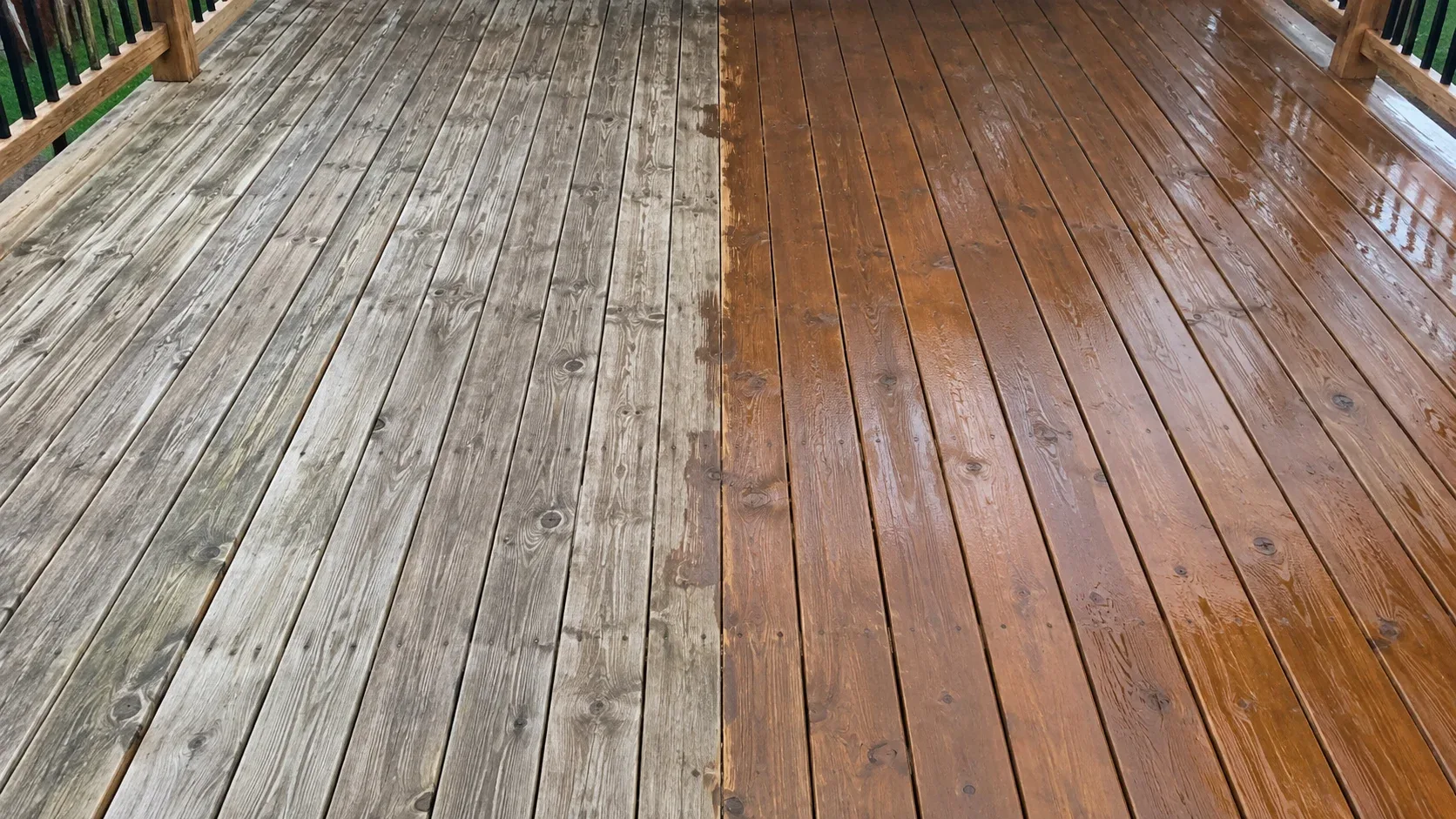
A repaired wood deck that is left bare will be back on our list within about four years, and the second visit is never the pleasant kind. Once the structure is sound, get a finish onto it.
The staining and sealing page covers the schedule and what it costs. Against what it prevents, it is the cheapest thing we do.
Communities we repair decks in
Across Columbus, Dublin, Upper Arlington, Westerville, New Albany and Powell.
The pattern changes with the ground. Around the newer Dublin and New Albany subdivisions the structure is often sound and only the builder grade surface has worn out, which is a much easier conversation than the one about a ledger. On shaded wooded lots the reverse holds, because damp framing and fallen debris keep water against the timber.
Deck cost in Columbus, OH
Set the size and finish, then read the installed range we price from before anyone picks up a phone.
Why homeowners pick Columbus Custom Decks
Piers set below the frost depth
Ground in central Ohio lifts and settles with every freeze. Each post lands on a poured pier that reaches past the frost depth, and that is what keeps a deck flat across a decade of heave and thaw.
Approvals and sign off dealt with
We prepare the drawings, lodge the permit and stand with the inspector, then hand you the signed approval. A deck built without one belongs to the seller at closing.
A written scope first
Boards, framing detail, fixings, schedule and cost all on paper before work begins. Any later change is documented and agreed, never verbal.
Deck Repair questions we get asked
How can I tell whether my deck is unsafe?
Four checks you can carry out yourself. Push hard against the top of the guard and watch for any movement. Look along the line where the deck meets the wall for rust marks, a widening gap or timber that gives under a screwdriver. Walk the surface and feel for spring. Go underneath and inspect the post bases and anything resting on a concrete block. Any single one of those justifies an inspection, and the wall connection is the one that really collapses decks, since it cannot be seen from up on the boards.
Is repair cheaper than replacement?
The frame decides it and nothing else does. Where the joists, beams, posts and ledger are sound, renewing the surface and the guards costs roughly a third of a rebuild and buys another fifteen years. Where the frame is undersized, resting on surface blocks or face nailed to the house, repair is money put into a structure that will still have to come out. We give you that verdict in writing before any money changes hands.
Can you fix just one part of the deck?
Often yes, and it is frequently the right call. Replacing half a dozen soft boards, rebuilding one stair run or re footing a single post are all ordinary jobs. New treated timber set beside weathered boards will not match on the day it goes down, but it blends within a season or two once the whole surface has silvered. We would rather say that at the quote stage than let you expect a patch no material can deliver.
The deck bounces when people walk on it. Is that dangerous?
That spring usually means the joists are too small or spaced too far apart for the load, or that a beam has lost its bearing at one end. It does not mean the deck is about to drop, but it does mean the frame was built to the wrong span, and the movement grows as the timber dries. A mid span beam on its own line of footings often removes the spring for a fraction of a rebuild.
Does deck repair need a permit?
Swapping boards like for like generally does not. Structural work does, and that includes a replacement ledger, new footings, a rebuilt stair, changed framing or extra floor area. Which side of that line your job falls on also depends on whether you are in Columbus, Dublin, Upper Arlington, Westerville, New Albany or unincorporated Delaware County, and we tell you before work begins rather than after.
How soon can you come out and look?
Repair quotes and inspections are usually within a few days, and sooner where the deck is genuinely unsafe and you say so when you call. If something sounds dangerous on the phone we will tell you to keep people off it until we have seen it, and that advice costs nothing.